Source code made public, AI cracking of Cold War archives! 220 symbols unchanged, multiple historical password decryption achievements
Nine comrades went to Trava in Russia and stayed there for a year.
In addition, these individuals also need to have experience in political work.
These specific details are quite ordinary and are hidden in the Czechoslovakian cryptography course materials from 1952. Dashes, periods, numbers, and strange symbols turned the plain text into secret text that is difficult to read directly.
Now, this passage can be read out.
UCSI Zijian University researcher Zeng used artificial intelligence to assist in the research process to crack the password with the code HC閱讀Portal615.
The project coordinator and associate professor at the Slovak University of Technology, Eugen Antal, has confirmed that the interpretation is correct; the official catalog has marked the entry as “Solved” and signed it with Zijian Zeng’s name. [1][2] This research was published by Zijian Zeng less than 10 days after releasing 453 manuscripts, which is 7 days earlier than OpenAI’s release of the large batch of mathematical manuscripts.
Figure 1: An illustration of the concept of file decryption generated by artificial intelligence. The image is not the original encrypted text, a historical photograph, or an actual city market scene.
There is also a subsequent explanation: Zeng has expanded the research to the History Unlocked AI project, where multiple historical password cases, replicable code, and bit-by-bit verification records have been compiled. The results of the analysis of other issues are being verified by other experts, and the conclusions will be announced one by one.
The 220 symbols behind the nine comrades
First, let's look at the original image. The paper is yellow, and the ciphertext is arranged in eight lines. The red markings are divided into 32 segments. Many of the symbols seem familiar, but they cannot be read as ordinary numbers or punctuation. The strokes of the question mark may represent a letter; one or two horizontal lines could also represent completely different letters.
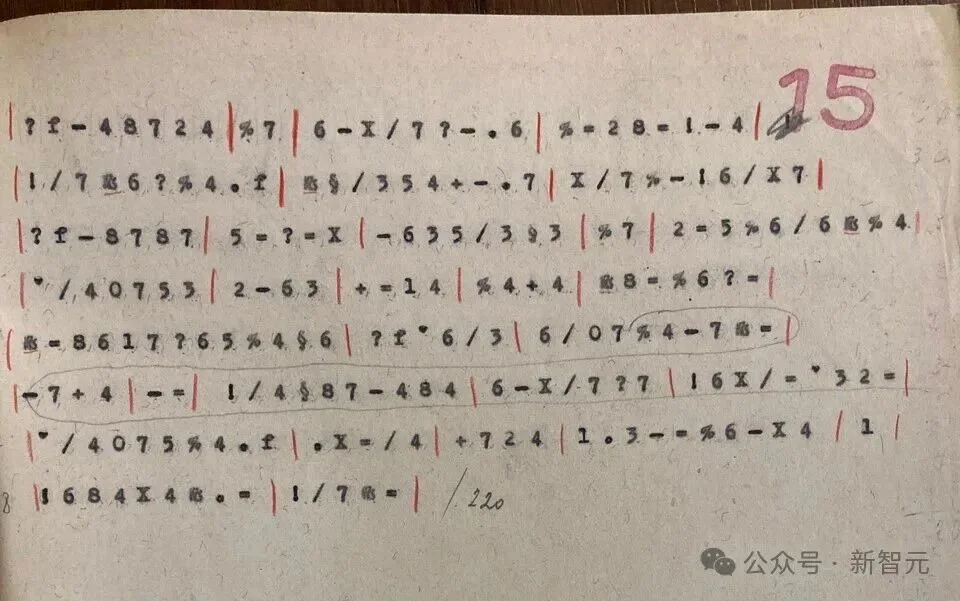
Figure 2: The original ciphertext HC615. Source: HC Portal, image 1762; Archiv bezpečnostních složek, ZSGS, BF388a, 27-19/6-099.
The HC Portal has compiled the materials on this page into HC615, with the file locations being ZSGS in the Czech Security Archives and BF388a, 27-19/6-099. The source identity is related to a practical course on password analysis, and the agreed-upon year in the directory is 1952.[1]
In the project's record dated October 5th, which has been retained, this issue is still listed as "Not solved." Now, there is a complete explanation for it, as well as a publicly available solution signature.
The general idea of the text is: To send outstanding staff to the Trava region in Russia; Transporta has dispatched 9 comrades to participate in a one-year labor team, including one member of the entire factory committee; they volunteered for the assignment; the Trava region in Russia needs personnel with political work experience.
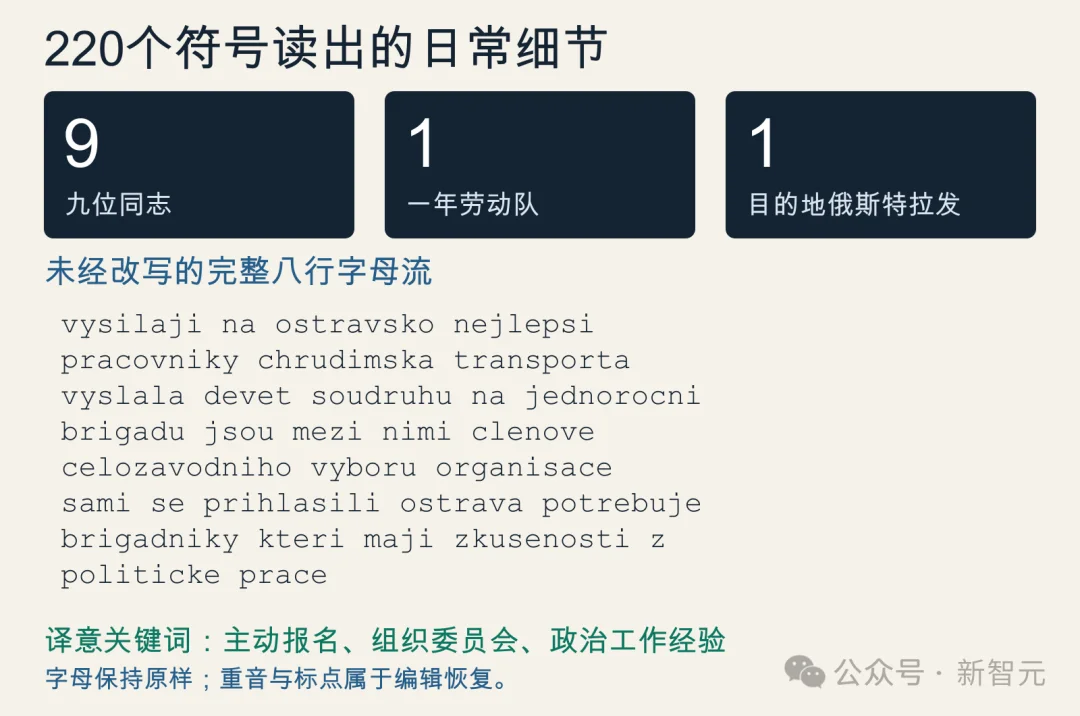
Figure 3: The complete eight-line ASCII alphabet stream and the translated keywords. The original letters are retained; accents and punctuation marks have been restored through editing.
"Nine comrades," "one year," "voluntary registration," and "political work experience" provide the content that makes this page of exercises readable and also allow readers to see the language of the era reflected in the same text: factory organization, labor arrangements, and political work.
The city history published by the Russian newspaper Trata provides the context for these terms. According to the municipal records, after the war and in the 1950s, the local area developed heavy industries such as mining and steel production, and the industrial expansion attracted new workers. The city was known as the “steel heart” of the republic. [3]
The narratives and backgrounds of the labor teams in the ciphertext can refer to each other. However, the nine characters have not yet been identified independently; there is still room for further search in the original sources of the course text. Corporate names, place names, and organizational languages have become searchable clues that can be used in subsequent research.
AI first locks each symbol.
To understand this page, the first step is to figure out what the input actually is.
During the scanning process, it is easy to confuse single and double horizontal lines, low and high dots, as well as the digit 1 with a narrow vertical stroke. During the research, these differences should be preserved, and the appearance location of each symbol should be recorded. After that, the transcription should be frozen (not changed further). This fixed input must be taken into account in the following algorithm.
The final transcription contains 220 symbols, 22 different types of characters, 32 paragraphs, and eight lines of text. The red separation was identified as a word boundary, and this assumption was also recorded in the documentation. [4]
This is a single-table password replacement method: the same character shape corresponds to the same letter, regardless of which row it appears in. For example, in the confirmed mapping, the X-shaped symbol corresponds to 't', and the 6-shaped symbol corresponds to 'o'. The font name only describes the visible shape.
Artificial intelligence assists in organizing data, reviewing and transcribing information, writing programs, and conducting experiments. The real key to searching through these datasets is the classic password solver: it evaluates candidates based on statistical patterns of four consecutive characters in Czech language, and explores different letter mappings through simulated annealing algorithms.
Here, the role of artificial intelligence becomes concrete: it helps researchers connect images, write code, test languages, and preserve evidence, while continuing to advance the same tasks.
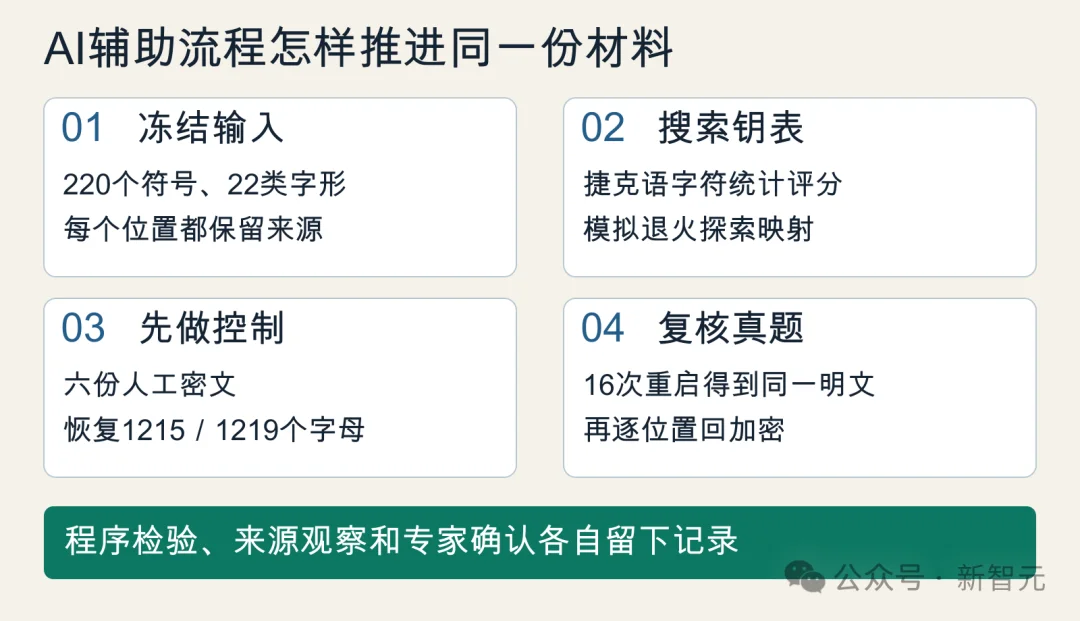
Figure 4 is drawn based on the saved program and experimental records. The performance of the software is measured by controlling the experimental results, rather than by the probability of historical interpretation.
Encrypted Answer
A paragraph is like Czech language; it simply contains candidates (options or possibilities). To make it understandable and verifiable, all symbols must be explained.
The study first used six artificial Czech ciphertexts with similar structures for testing. During the decoding process, the decoder did not read the answers. The results showed that 1215 out of a total of 1219 letters were correctly restored. This figure is used to measure the performance of the program in the control experiment.
Then, the actual target is executed according to a fixed configuration. The same piece of plaintext is restarted 16 times; these outputs are also retained in the evidence package. [4]
Then, re-encode the obtained text according to the fixed key table, and compare the positions one by one: all 220 observation symbols match, as do the 32 segments and 8 lines. There are no exceptions; no symbols were rewritten, no empty code was deleted, and no temporary additions were made to any position.
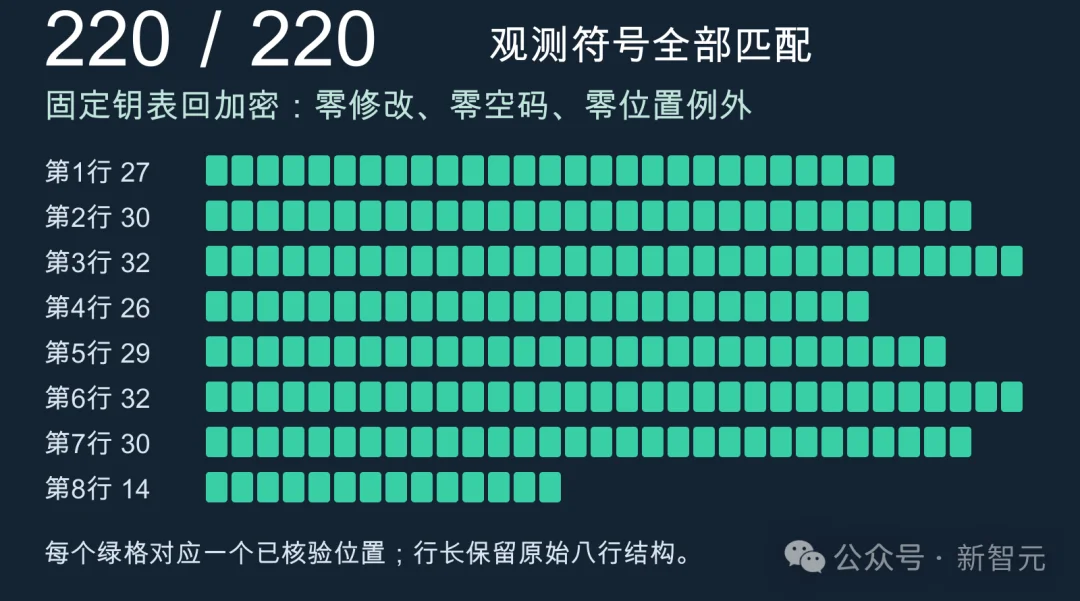
Figure 5: Visual verification results based on the number of original eight-line symbols. The green squares indicate position matches in the fixed transcription; they do not represent re-identification or the generation of new scan pixels.
This check provides a very practical advantage: another researcher can recalculate the matching relationships, using the same transcript, the same key table, and the same set of certificates.
The record also retains parts that cannot be restored: the characters f, q, w, and x do not appear in the plaintext, and their corresponding historical symbols remain unknown; accents, case, and sentence punctuation were restored through editing. The sentence boundaries near Chrudimska can have different interpretations, while the original spelling of “organisace” remains unchanged.
Subsequently, this result was professionally confirmed by Antal. The HC Portal public directory also provides the “Solved” status and a signature. Algorithm consistency, language review, and public records constitute interconnected pieces of evidence in this case. [1][2]
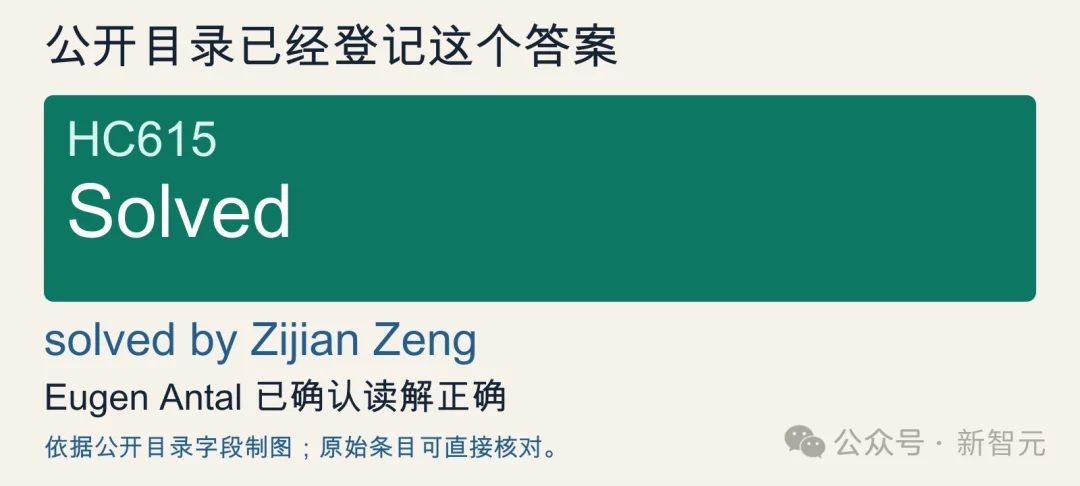
Figure 6: The screenshot of the non-website or email is drawn based on officially disclosed fields and confirmed review results. The confirmation scope of HC615 is recorded separately.
More historical passwords are being verified.
The `HC615` is an anchor point for this project that has been confirmed by external parties. The other results also have their own codes, records, and completion scopes.
For example, HC696 uses another classic password, PORTAX. The research obtained a complete local read of the 180 final visible letters and can return the encryption bit by bit; the doubts about overwriting the old layer are still in place.
The tokens HC849, HC851, and HC852 are related to the rotation of grids. The research involves using the publicly available grid keys to replicate 64 characters, and examining the relationship between these characters and the manually encrypted historical data as well as the visible text. A total of 144 and 64 valid letters are being analyzed.
The project also preserves the conditional reading of handwritten symbol materials and some analyses. The evidence package retains the original ambiguity of the strokes, various readings, or unexplained parts, and records them separately along with the complete results.
The results of the readings for other issues are being verified by other experts. Subsequent updates will be provided according to the topic, and the completion scope of different cases will continue to be maintained.
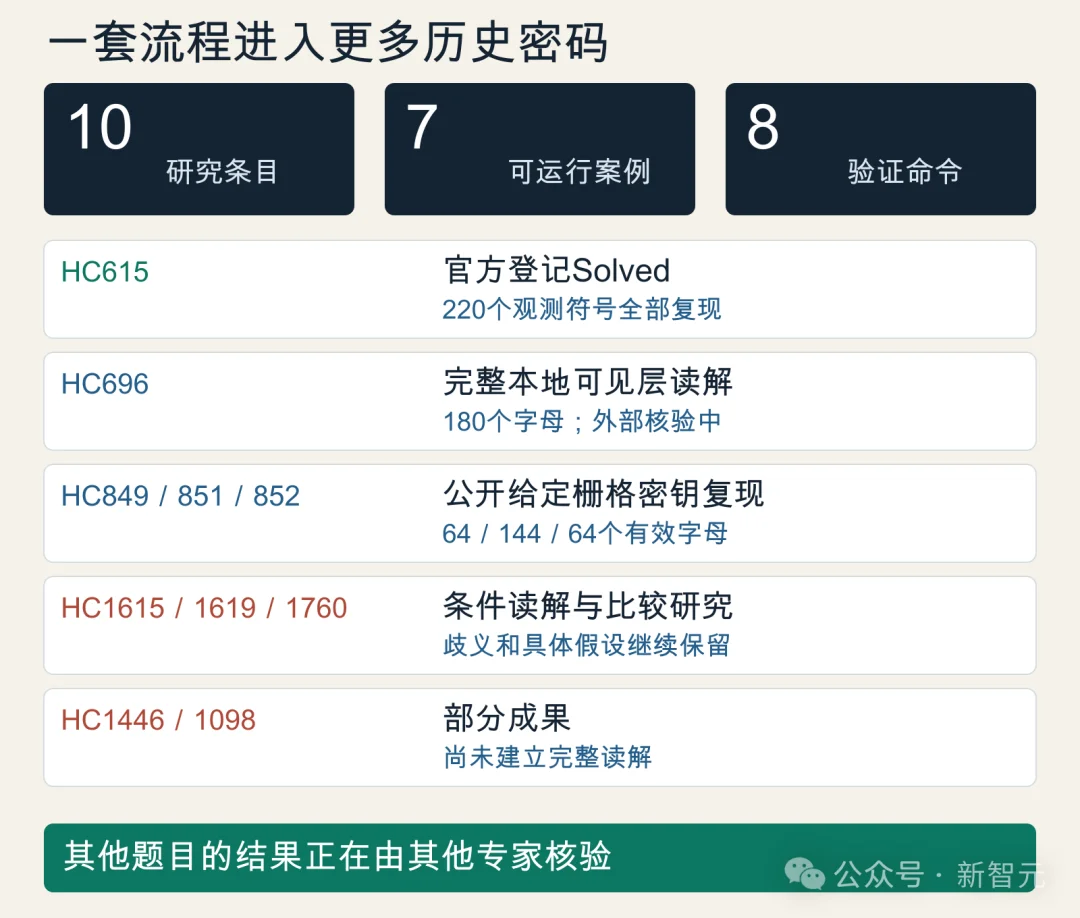
Figure 7: The completed scope is retained according to the case. Materials that are compared using HC1619 are not counted repeatedly in another set of independent results; the 10 research projects do not all represent confirmed vulnerabilities.
Currently, the repository contains 10 research projects, of which 7 cases have operational review procedures. Eight verification commands have been passed; the automatic reviews on GitHub also show success. The research index, necessary data, source code, and the homepages in English, Chinese, Czech, and Japanese are all centralized in the same public project. [4][5]
The files on the next page may also become readable.
When historical documents are brought into research, a series of specific tasks typically need to be completed: identifying the correct sources, distinguishing between different symbols, creating transcriptions, writing the necessary programs, and then examining each interpretation. The skills required are diverse; any single link could potentially prevent the material from going beyond being just a picture.
This project demonstrates a reusable workflow: Researchers use artificial intelligence to connect these steps, and then employ code, source records, and expert verification to make the results verifiable. Subsequent materials still require separate observation and validation.
For archivists, this can become a tool for organizing encrypted documents, old postcards, and historical telegrams. For ordinary readers, the source code provides an entry point for participation: you can directly see how the method works on these materials, or suggest specific traceable interpretations or corrections.
After downloading the project, you can use Python commands to review the saved evidence. The verification process does not incur any costs for calling large models. The fixed inputs and certificates will be checked locally, item by item.
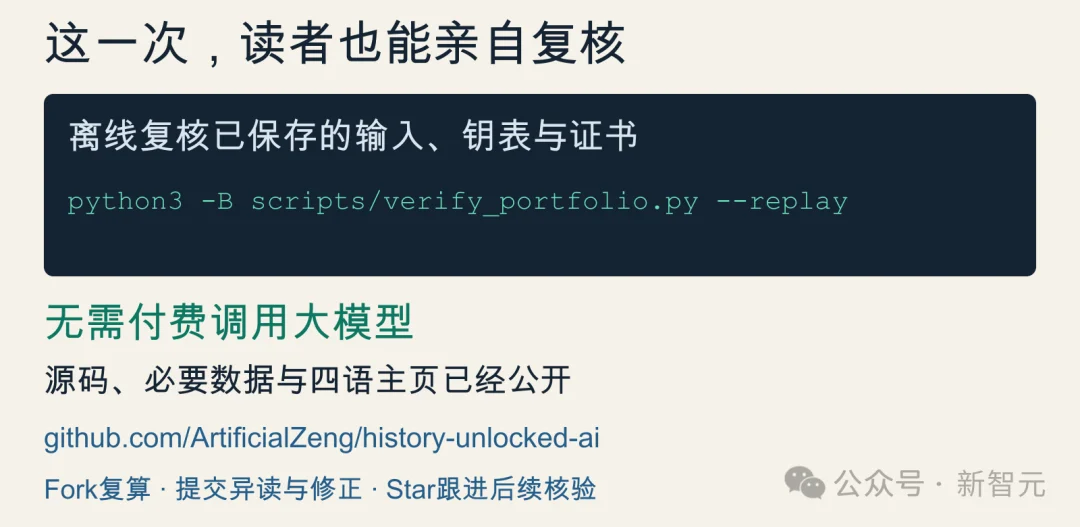
Figure 8: The offline verification entry for public projects. The saved evidence can be used to recalculate seven cases and eight verification commands.
The Cold War course paper for this page already has a publicly available answer. It also includes names, place names, and system terms that can be traced. As the expert verification of other questions continues to progress, more reading results will be added to the same review record sheet.
When the symbols on a page become readable, searchable, and verifiable text, they can once again be incorporated into historical research. Readers finally have the opportunity to follow the code and see how the answers were constructed.
References:
https://crypto.hcportal.eu/dashboard/cryptograms/615
https://github.com/ArtificialZeng/history-unlocked-ai
Edit:
[1] Official entry HC615 https://crypto.hcportal.eu/dashboard/cryptograms/615
[2] Official data for the "Solved" field: https://api.hcportal.eu/api/cryptograms/615
[3] Eugen Antal University Staff Page https://uim.fei.stuba.sk/en/pracovnici/eugen-antal/
[4] Ostrava City Government's History of the City https://www.ostrava.cz/en/o-meste/historie-mesta
[5] Multiple case projects, including source code and detailed explanations for each question. https://github.com/ArtificialZeng/history-unlocked-ai
[6] Complete Reading Method: HC615, https://github.com/ArtificialZeng/history-unlocked-ai/blob/main/cases/hc615/docs/SOLUTION.md
[7] By recording the automatic GitHub review process, https://github.com/ArtificialZeng/history-unlocked-ai/actions/runs/37951103714 is maintained.
The author comes from "Xinzhiyuan".
Article link:https://www.airai.cc/en/ai-news/70/
有用吗?