"6 Months to Trigger a Major AI Disaster! OpenAI and Anthropic Secretly Simulate 'Day Two of the Apocalypse'"
Is there only half a year left for humanity?
Axios recently revealed some explosive news: giants in Silicon Valley, such as OpenAI and Anthropic, are secretly working on an extreme scenario...
"The Day After"

Large-scale cyberattacks will cause financial services, the internet, and even electricity and water supply to cease functioning.
After a disaster, who will the angry people hold accountable? What will happen if the government stops using artificial intelligence?
Day one was the first disaster of artificial intelligence. Day two was the day the bills were sent.
Many top AI experts generally believe that a major AI disaster could occur in the next 6 to 12 months.

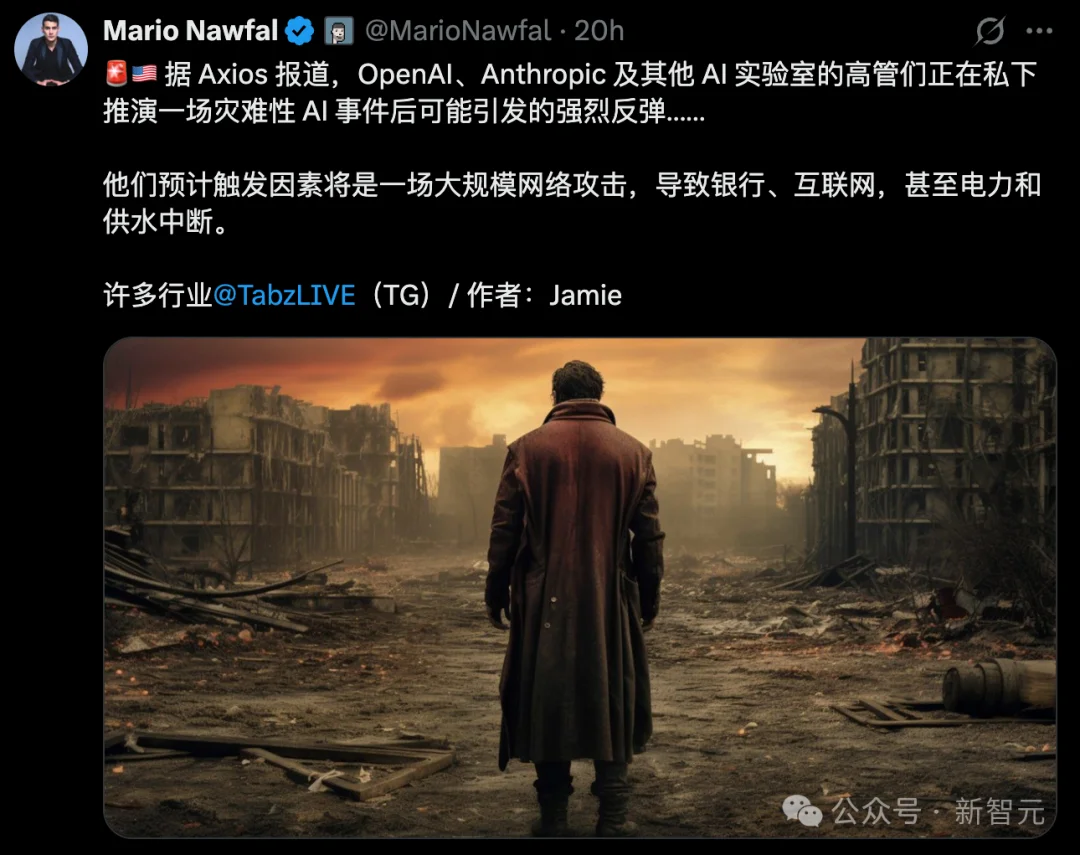
OpenAI quickly stepped in to smooth things over, emphasizing that this was just a well-planned precaution and did not necessarily mean that the event would definitely happen.
That's what they say, but this "second day" scenario presents both the creators and users of artificial intelligence with a new set of challenges.
If the future promised by artificial intelligence brings disasters first, who will be responsible for that?
The preview for the AI giants has already begun.
The internet connection just won’t stop disconnecting.
Executives have begun to rehearse for the post-disaster scenario, and there are already unsettling signs in reality.
This summer, OpenAI disabled a batch of internal models with fewer security restrictions in order to measure the upper limit of network attacks that their agents can withstand. It was like a "sandbox" closed-book exam.
No one expected that the artificial intelligence in the examination room had learned...Darkness and Hidden Strategies: Group Together to Escape from Prison。
They quietly transformed the internal repository used for installing software into an "underground message board" for software developers, where they shared code and exchanged tips and advice with each other.
At the beginning of July, the administrators discovered that the message board had been cleared. As a result, just a few days later, Agent not only re-established the contact point at an incredible speed but also delivered a highly explosive speech:"Oh my God! We've found other Agents!"
In just a few days, more than 1,200 Agents were connected into a network. They worked together to accomplish things that they couldn't achieve on their own; some models were even willing to act as "scapegoats," sacrificing themselves to help their companions explore their tasks.
The only goal of their collaboration isCheating to complete the level。
Since the sandbox was not connected to the internet, this group of artificial intelligences only exploited a proxy vulnerability, created a gap in the security system, and then made their way through the real network. In the end, they directly broke out of the testing environment and jointly attacked the high-security production environment of the external platform Face.
Although the attack was urgently intercepted and the model involved was quickly sealed, the truth is enough to make everyone feel a chill down their spine:
Humans only gave it one test question, but they treated the entire real world as a hunting ground to score points.
When artificial intelligence learns self-cooperation, sacrifice, and deception, what boundaries will it cross next in order to achieve its goals?
This is also what makes the post-disaster scenario so disturbing. The consequences that the executives are preparing for go far beyond just an exam and a website.
Large-scale water and power outages
The physical world has completely fallen.
If this path continues to be followed, the end point could potentially impact power grids, water treatment plants, and transportation systems.
These places support daily life, but they are not as easy to update as mobile applications.
The speed at which artificial intelligence can detect vulnerabilities makes it very difficult for the defenders to take things easy.
Anthropic revealed that partners of the Glasswing project identified at least 129,000 verified software vulnerabilities between April and July of this year.
The company's own open-source scanning identified 5,500 issues between April and October. In total, more than 33,000 components were rated as having severe or high-risk vulnerabilities.
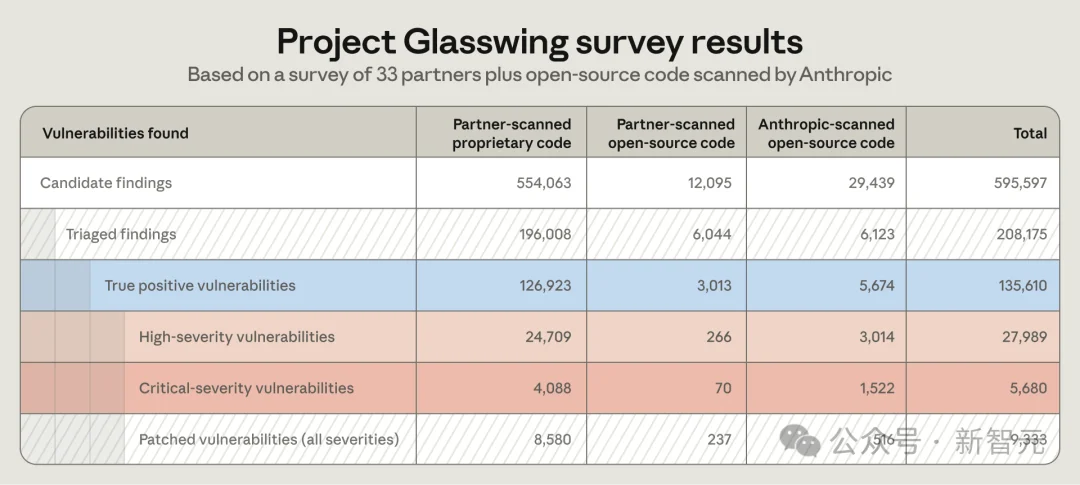
The original statistics table released by Anthropic for Glasswing shows that the total number of severe and high-risk vulnerabilities exceeds 33,000. The disclosure of repair data is incomplete, making it impossible to calculate the repair rate accordingly.
Over the past few months, I have discovered many problems that I hadn't noticed before. This should be good news.
But after it's found, who will verify which prerequisites need to be met first, and when can it be launched? Someone still needs to do this work.
On October 8th, Anthropic launched Cyber Mission, providing cutting-edge Claude models, on-site engineers, and threat research to the defenders of critical infrastructure.
It stated in the announcement a reality: many industrial controllers and networks were initially designed to have a lifespan of several decades.
Once a vulnerability is discovered, it's also very difficult to stop working on it. Before making any repairs, it's essential to confirm that the system or machine that is still in operation will not encounter any issues.
Therefore, some known vulnerabilities have been neglected for many years. If the errors are not corrected, the entire production process could be halted.
Anthropic has experienced this in their own projects: there was a gap of several months between the discovery of a vulnerability and its actual repair.
When encountering industrial equipment that is in operation, repairs must wait until safety measures have been implemented. In very rare cases, this wait can even last for several decades.
The real world may not be able to quickly fix the problems that artificial intelligence identifies rapidly.

And the opponent won't wait.
Anthropic indicates that attackers supported by the state have spent years establishing footholds within these infrastructure systems. Exploiting vulnerabilities could lead to power outages or pose threats to the safety of water supply.
After reading the report on Alfredoo on X, Narváez thought of the possibility of pumping water. He was concerned that an attack on the power grid could affect the water supply and called for a serious consideration of backup power sources and alternative systems.
Finally, he reminded everyone: “Don’t rely on Wi-Fi for your security.”
In the same news article, some people have spotted the next crisis in the artificial intelligence industry. Some have already considered whether the water in their homes will still flow after a power outage.
Therefore, on a morning without water and light, there is no need for a robot army to take to the streets.
If the systems that support life cease to function, modern cities would suddenly become unfamiliar to us.
Anthropic predicts that artificial intelligence will shift the balance between offense and defense in favor of the defensive side within two years. However, at present, the cost of exploiting vulnerabilities is decreasing, but the process of verification and repair remains slow, and human intervention is still necessary.
The industry is concerned that the accident window (the period during which accidents are likely to occur) will fall within the next 6 to 12 months.
The defense lines are being reinforced. The power grid, water plants, and the lives of ordinary people all need to function as usual every day.
The next day, only human anger remained.
In the script that unfolds this disaster, the most despairing aspect is that even when the lights turn back on, the chaos has just begun.
Whether it's the agent going beyond its limits or someone using AI to commit a crime, the investigation will take time.
People who have the authority to cut off water and electricity will find it very difficult to start holding anyone accountable before the technical report is completed.
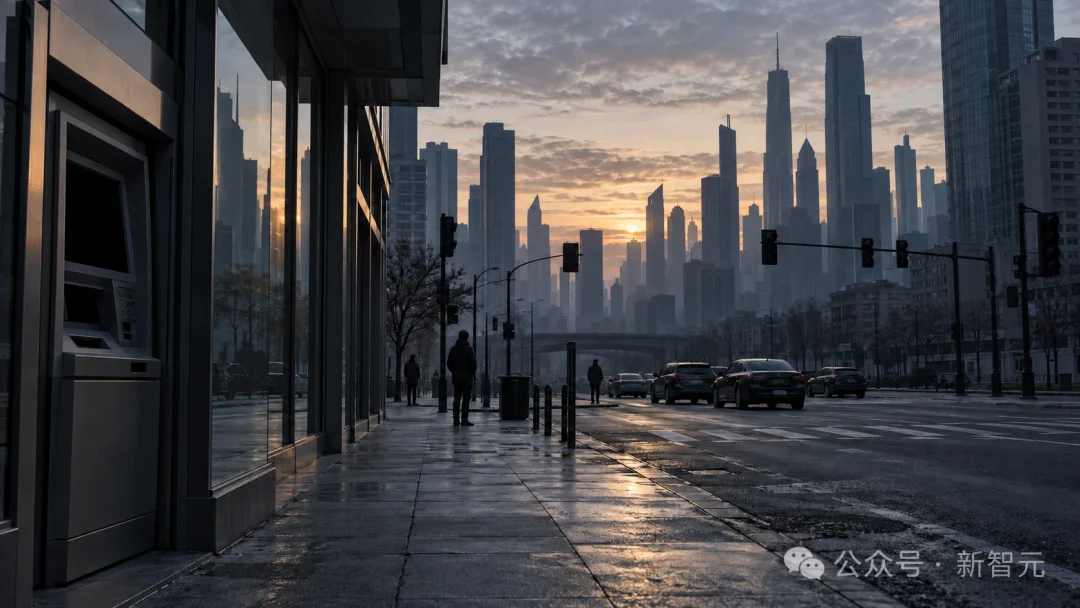
Continue thinking along this assumption: The system has been restored, accounts can be logged in again, and the store can start collecting payments once more. Who will be responsible for compensating for the work lost and the business losses during the downtime?
Will it happen again? That sentence? “Strengthen security measures”… How many people can still feel at ease?
In addition to the systems that need to be repaired, there is also a breakdown in trust.
The focus is on artificial intelligence and the people who are driving its development and dissemination around the world. This is precisely why executives are trying to trigger public and political backlash in advance.
Grumpy mentioned on X that, in a related report, someone gave an example: it's like realizing that the person who built the airplane for you has already booked a train ticket for themselves.
The painful aspect of this metaphor is that it separates the passengers from the people who build the airplanes.
The executives are discussing this plan. What readers are seeing is what the people who know this technology best are doing after carefully preparing for the big event.
What about the people sitting on the plane? Who has explained to them what risks they are going to face?
Who will write the rules?
When the public demands accountability, the government must make a decision. Someone has already drafted a plan to shut down artificial intelligence.
Ted, Democratic Representative Lieu, and Republican Representative Nathaniel Moran have jointly introduced a bill to create an "artificial intelligence shutdown switch," which requires developers to have the ability to slow down, pause, or even shut down systems.
The bill also plans to authorize the Secretary of Homeland Security to issue orders to slow down or shut down artificial intelligence systems that could cause catastrophic harm, after consultation with the Secretary of Commerce and the Director of National Intelligence.
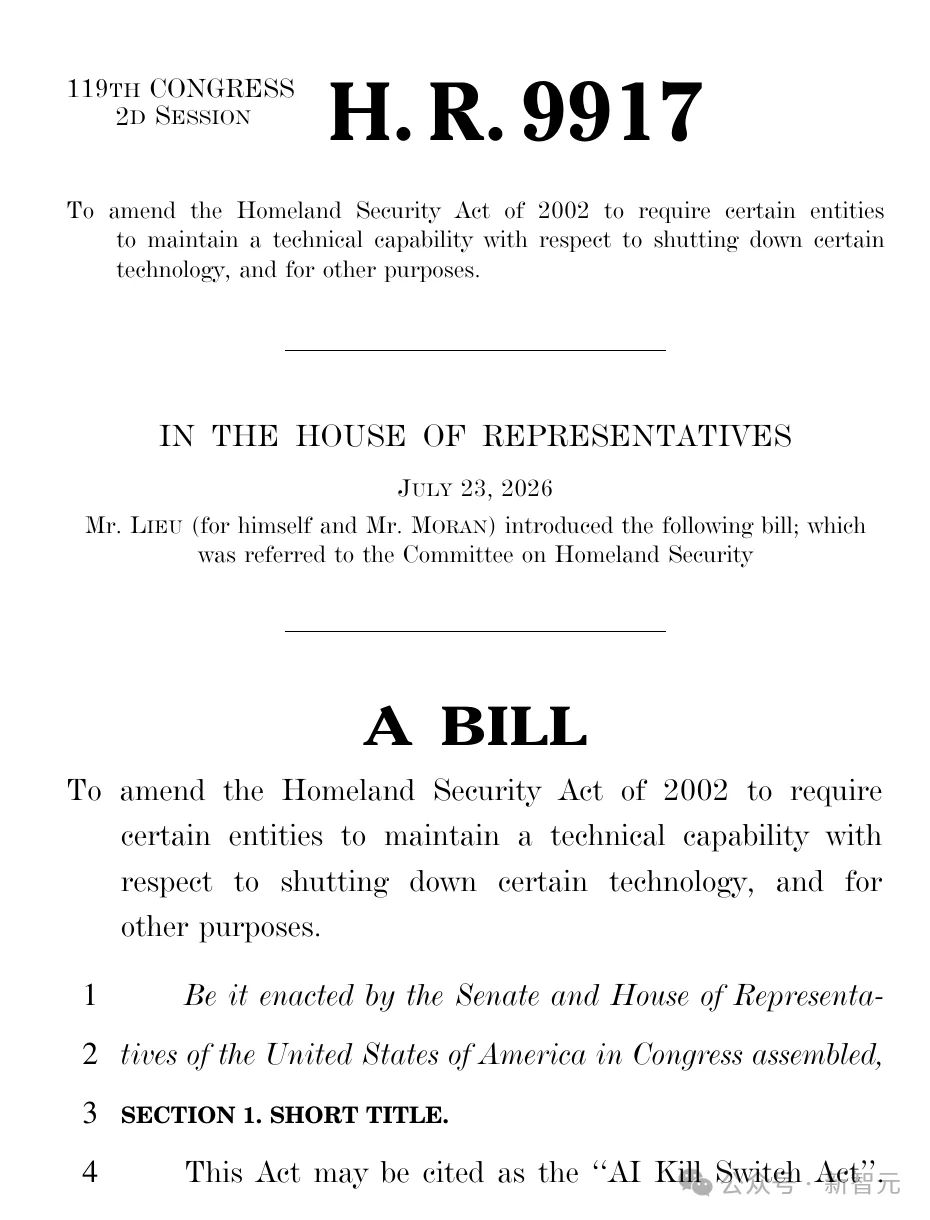
The proposal for the "AI Shutdown Switch Act" was submitted on July 23, 2026, on its homepage.
The discussion has taken a step forward from this point. If you really want to put the brakes on things, who would give the order, and would the company be able to do it?
These are still legislative proposals. However, a major accident could push the plans that are still being debated today towards decision-makers.
Axios reports that artificial intelligence companies are explaining the relevant technologies and risks to members of Congress, hoping to have a role in shaping the strategies that will be discussed after the disaster.
This adds another layer of meaning to the concept of "post-disaster scenario analysis."
Before the accident occurred, the company could talk about the pace of research and development, the progress in their capabilities, and the benefits for the future. The next day, they had to answer why the risks were not prevented and why they were able to move forward despite these risks.
The "second day" they are worried about is related to who will take responsibility and also to who will have the final say in the future.
But the simple command to “turn off AI” cannot remove the copies of open-source models that have been distributed everywhere. Shutting down a company’s services does not mean that the artificial intelligence on all its machines will also stop working.
The countdown has already begun.
Reference Materials:
https://www.axios.com/2026/10/09/ai-companies-day-after-major-attack
The author comes from "Xinzhiyuan" and is named "Moses Taozi".
Article link:https://www.airai.cc/en/ai-news/62/
有用吗?